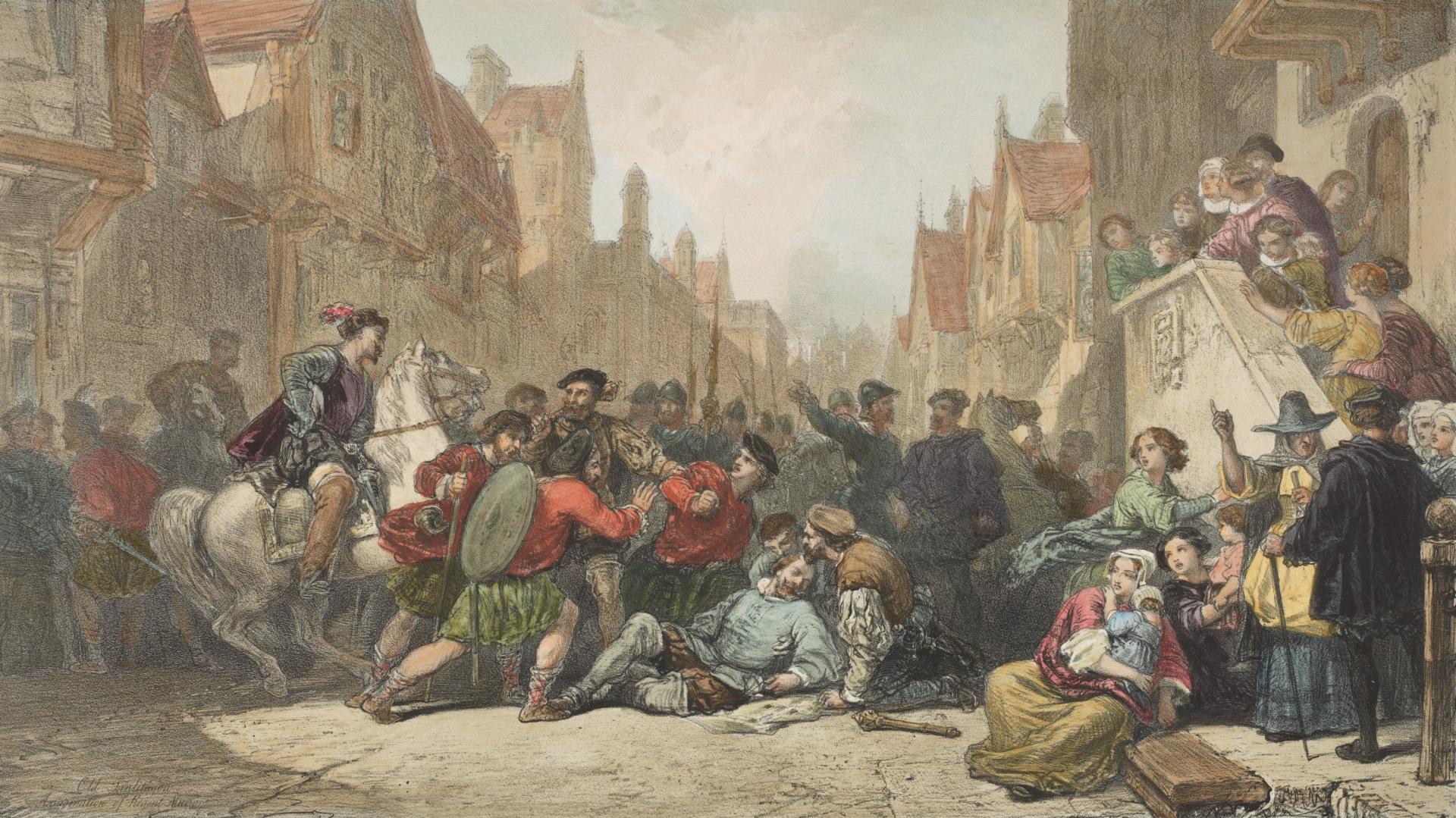
The Regent Moray was riding through Linlithgow on 23 January 1570 when a single gunshot changed Scottish history. The ball struck James Stewart, 1st Earl of Moray, below the navel. Although he managed to dismount and walk to lodging, he died the same day, near midnight.
His death matters for two reasons. First, he was the Regent of Scotland, ruling for the child King James VI. Second, contemporary and later accounts describe the killing as the first recorded assassination by firearm.
But what led his Assassin to take such drastic action?
James Hamilton of Bothwellhaugh, like most of the Hamilton family, supported Mary Queen of Scots and fought for her at the Battle of Langside. Though Hamilton was captured, his life was spared.
There is a legend that claims that after the Battle, Hamilton was forced to give up his home, Woodhouselee, to a relation of his wife, Sir James Ballenden. Keen to claim what was now his, Ballenden cast Hamilton’s wife and child out of the house in the middle of the night and allowed them to perish in the bitter cold. To this day, their ghosts are said to haunt the old castle and their screams can still be heard.
Other tales say that it was a personal vendetta against the Regent Moray as he came to Bothwellhaugh in person and ignored the pleas of Hamilton, his wife and sister-in-law.
The Bigger Political Picture
However, on the political side, Hamilton’s killing of Moray fits the wider struggle between the King’s Party and the Queen’s Party. Sources describe it as a planned act with Hamilton family involvement and knowledge within their circle, including links to Archbishop John Hamilton’s house in Linlithgow. Moreover, contemporary commentary treats it as political, not merely personal. Shortly after Moray’s death, his secretary, Master John Wood, was murdered. Historians have used Wood’s killing to argue that this was a coordinated political crime rather than a lone act of rage.
What was the Cause of such Division?
This was the time of the Protestant reformation in Scotland, one of the bloodiest times in Scottish history. Moray was the illegitimate son of James V and Margaret Erskine. That made him the half-brother of Mary, Queen of Scots. When Mary returned from France in 1561, Moray became her chief adviser. Soon after, she made him Earl of Moray.
Yet politics and religion pulled them apart. Moray supported Protestant reform, and he backed figures such as John Knox. He also opposed Mary’s marriage to Henry Stewart, Lord Darnley, in 1565. As a result, Moray joined a rebellion against the Queen, which developed into the “Chaseabout Raid”, with Mary’s forces pursuing the rebels across southern Scotland.
Why was Moray Regent?
After Mary’s forced abdication in 1567, Moray became Regent for James VI. He governed effectively, but he also pursued a strongly Protestant programme. Additionally, he acted against families who remained loyal to Mary, including the Hamiltons.
That split hardened into open conflict. After Mary escaped Lochleven and raised forces, Moray led the army that defeated her at Langside in May 1568. Mary then fled into England, while Scotland remained divided between the King’s Party and the Queen’s Party.
The assassination: a planned shot from a window
The assassin was James Hamilton of Bothwellhaugh, a supporter of Mary. Accounts in your notes describe a careful ambush. Moray’s route took him along Linlithgow’s High Street. Hamilton gained access to a property linked to Archbishop John Hamilton. He fired from a window, reportedly screened by hanging sheets, and then escaped on a waiting horse.
Contemporary descriptions say Moray was struck in the abdomen. One account notes the shot came through a shuttered window, and that the hanging linens helped conceal smoke and suspicion. Moray’s party pursued, but Hamilton escaped.
What happened after the Regent Moray died?
Moray’s body was taken first to Stirling, then shipped to Leith, and brought to Holyrood. He was buried at St Giles’ Kirk in Edinburgh. John Knox preached at his funeral, despite earlier objections to funeral sermons.
Politically, the killing did not end conflict. Instead, it escalated tensions and helped push Scotland further into civil war. The next Earl of Moray’s life would also end in murder.