Name pronunciation:
KEL-pee
General Information:
Kelpies are the most common water spirits in Scottish folklore, and they are deeply feared as malevolent, shape-shifting beings. Although they are often described as water horses, these spirits personify the dangerous power of Scotland’s rivers and lochs. Because the country’s waterways are prone to sudden, violent floods, the legends of these creatures provided a natural explanation for drowning and loss.
Furthermore, the term has been used broadly throughout history. Early folklore collectors often recorded different spirits under the same name, while also applying various local titles to what may have been the same creature. As a result, the traditions surrounding kelpies often overlap with those of the each-uisge and other aquatic monsters.
Appearance:
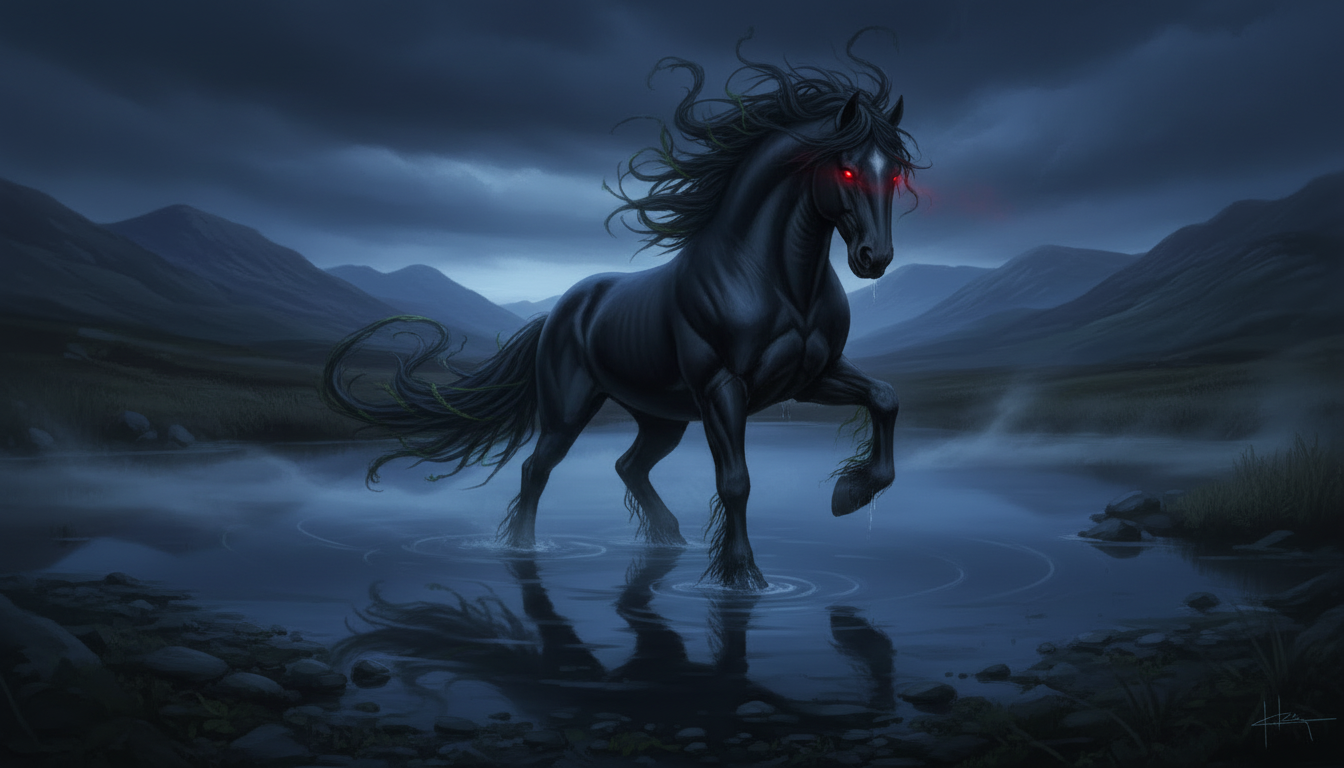
Kelpies are most frequently described as powerful, beautiful horses, usually black in colour. However, regional variations exist across the country. On the River Spey, for instance, the local spirit is traditionally white, while other accounts describe them as grey or even yellow.
A key identifying feature of kelpies is their reversed hooves. This subtle deformity distinguishes them from normal animals and has led many writers to associate them with the devil. Robert Burns famously alluded to this in his 1786 poem Address to the Deil, where he described how these spirits haunt the fords to lure travellers to their doom.
Habitat:
Kelpies are strongly associated with fresh water, particularly the deep, dark pools of rivers and streams. The River Spey is one of the most prominent locations for these legends. Because the Spey is known for its unpredictable and lethal spates, it was long believed that the river demanded at least one life every year.
While some folklorists distinguish these river spirits from the loch-dwelling water horses, this line is often blurred. Sir Walter Scott suggested that the range of kelpies could extend to lochs as well. Consequently, almost every sizeable body of water in Scotland has a story attached to it.
Behaviour:
Kelpies are deceptive predators that seek to lure humans to their destruction. They often appear docile and inviting, tempting footsore wanderers to mount their backs for a ride across a river. However, once a victim is seated, the creature’s true nature is revealed.
Its hide becomes adhesive, fixing the rider firmly in place so that escape is impossible. Then, the spirit bolts at great speed towards the deepest water and plunges in. Victims are drowned and devoured, and several traditions describe the gruesome sight of entrails floating to the surface later.
However, it should be noted that the kelpie is less dangerous than its cousin the Each uisge.
Shape-shifting Ability:
Kelpies are master shape-shifters. While their equine form is the most famous, they frequently adopt human guises to interact with people. They may appear as handsome suitors to woo young women or as shaggy men who leap behind solitary riders to crush them.
However, the transformation is rarely perfect. Water plants such as rushes, goosegrass, or algae are often found tangled in their hair. In some traditions, they retain their hooves even when human. These small details acted as vital warnings to those who knew the folklore.
Variant:
Kelpies appear in different forms depending on the local landscape and tradition.
- The White Horse of Spey: A variant that appears during storms and sings to entice victims.
- Aberdeenshire Kelpies: Often described as having a mane made of serpents.
- Northern Isles: Related beings include the nuggles of Shetland and the tangies of Orkney.
- Loch Dwellers: the more dangerous Each Uisge or Water horse.
Beyond Scotland, parallels exist with the Welsh ceffyl dŵr, the Manx cabbyl-ushtey, and the Scandinavian bäckahäst. Despite the different names, the theme of a deadly water horse remains consistent.
Location in Scotland:
Kelpies are found in legends throughout the Highlands and Lowlands. The River Spey is especially rich in these stories, particularly around the fishing pool known as Pot Creavie. Other notable sites include the River Don, Braemar, and the island of Barra.
In the modern day, the most striking tribute to these myths is the pair of 30-metre-high steel sculptures known as The Kelpies. Located at The Helix Park between Falkirk and Grangemouth, they stand as a magnificent reminder of Scotland’s ancient folklore and its horse-powered heritage.
Stories/ Sightings or Experiences:
The Singing Spirit of Pot Creavie
Kelpies on the River Spey were often blamed for the loss of life during floods. One specific legend tells of a white horse that appeared on stormy nights when thunder echoed through the hills. It would walk beside weary travellers and offer them a ride.
Once the traveller was mounted, the creature galloped into the deep pools of the river. Tradition says it sang a dark promise as it carried its victim to a watery grave:
“And ride weel, Davie,
And by this night at ten o’clock
Ye’ll be in Pot Cravie.”
The Laird of Morphie’s Curse
Kelpies were occasionally captured and forced into service. The Laird of Morphie once used a magical bridle to subdue a spirit and force it to haul heavy stones for his new home. Upon its release, the exhausted creature issued a curse that supposedly ruined the Laird’s family:
“Sair back and sair banes,
Drivin’ the Laird o’ Morphie’s stanes,
The Laird o’ Morphie’ll never thrive,
As lang’s the kelpy is alive.”
The Silver Necklace of Barra
Kelpies do not always end their stories in violence. On the island of Barra, a girl recognised that her handsome suitor was actually a water spirit. She removed his silver necklace while he slept, which forced him into horse form. After a year of farm work, the spirit was given the choice to remain a monster or become mortal. He chose to marry the girl and live as a human man.
MacGrigor and the Willox Bridle
Kelpies are often tied to their magical tack. At Loch Ness, a Highlander named James MacGrigor managed to cut the bridle from a spirit that had been terrorising the shore. He outwitted the creature by tossing the bridle through his window, past a cross that the spirit could not pass. This bridle was later said to have healing powers.
Purpose of the myth or Legend:
Kelpies served several practical purposes in historical Scotland. Primarily, they kept children away from dangerous riverbanks and warned women about the perils of strange men. Because many people could not swim, these stories provided a necessary lesson in safety through the medium of terror.
Furthermore, the legends helped rationalise the tragedy of accidental drownings. Some historians suggest the myth may have been inspired by waterspouts on lochs or the wheeling eddies of a torrent. Whether as a moral lesson or a natural explanation, the legend remains a haunting symbol of the Scottish wilderness.