The Flannan Islands Mystery is one of Scotland’s most enduring maritime mysteries. It was Boxing Day 1900 when the Hesperus was finally able to reach Eilean Mor on the Flannan Islands. Storms had delayed their arrival. Imagine the crew’s horror when they discovered the Island uninhabited and the Lighthouse Keepers missing. What had happened to them?
Scotland’s Islands are otherworldly at the best of times. With Lewis’ Stone Circle at Calanais and Skye’s Fairy Flag, there is a sense that the Islands are liminal places. But when Lighthouse Keepers vanish into thin air, it is small wonder that some people turned to the supernatural to explain what happened.
Where Are the Flannan Islands?
The Flannan Islands, also known as the Seven Hunters, lie about 20 miles west of the Isle of Lewis in the Outer Hebrides. Uninhabited and exposed to the full force of the Atlantic, they are little more than steep, grass-topped rocks rising from the sea.
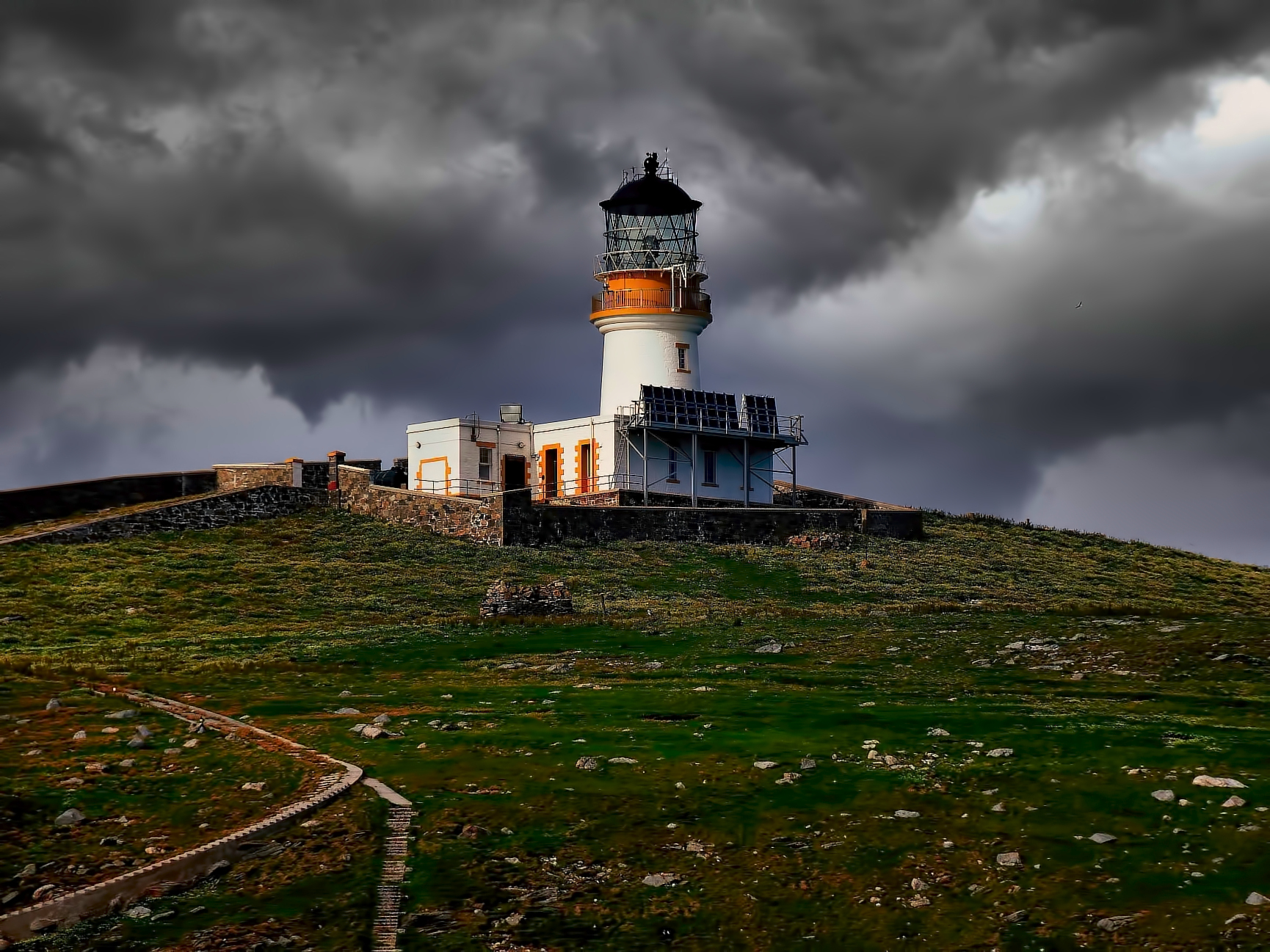
In 1899, a lighthouse was completed on Eilean Mòr to guide ships through this dangerous stretch of water. The stone tower, 75 feet high and built more than 150 feet above sea level.
During December 1900, the three men stationed at the Flannan Islands lighthouse were:
- James Ducat – Principal Keeper
- Thomas Marshall – Second Assistant
- Donald MacArthur – Occasional Keeper, standing in for the regular third man, William Ross, who was ill
All three were experienced lighthousemen, trusted with keeping the light burning on one of the most exposed posts in Scotland.
The First Signs of Trouble
The first indication that something was wrong at the Flannan Islands lighthouse came from a passing vessel.
On 15 December 1900, the steamer Archtor reported that the Flannan light was not visible. In winter, storms often delayed relief visits, but a dark lighthouse on such a perilous coast was alarming.
Bad weather in the Minch meant that the lighthouse tender Hesperus, due to bring supplies and the relief keeper, could not sail on schedule. It finally reached the Flannan Isles on 26 December 1900, eleven days after the light had last been seen.
Captain Holman of the Hesperus and relief keeper Joseph Moore expected to see signs of life – a flag, smoke, perhaps a figure on the landing. Instead, the island looked deserted.
No one waited at the landing. No signal flew from the flagstaff. The Flannan Islands mystery had begun.
An Empty Lighthouse on Eilean Mòr
Moore went ashore and climbed the long stone stairway from the landing to the lighthouse on Eilean Mòr.
What he found was unsettling:
- The main door was closed, but unlocked.
- Inside, the clock had stopped.
- The beds were unmade, as if the keepers had risen and never returned.
- In the kitchen, a meal appeared to have been prepared but not fully eaten, and a chair lay overturned.
- One set of oilskins and sea boots was still hanging inside – but two sets were missing.
Most disturbing of all, the lighthouse lamp was out. There was no sign it had been lit for days.
Moore and the crew searched the island thoroughly. There was no trace of Ducat, Marshall, or MacArthur. It was as if the three men had simply stepped outside and disappeared.
The Last Log Book Entries
The Flannan Isles lighthouse log book provided only a few clues. The final entries, up to 15 December 1900, recorded bad weather – strong winds, heavy seas, and winter storms – but nothing that seemed extraordinary for the Atlantic in December.
After 15 December there were no further entries. No mention of illness, accidents, or damage. No sign of growing tension or fear. Just silence.
Over the years, various dramatic “last entries” have been quoted, referring to strange behaviour, prayers, or unnatural storms. These lurid details do not appear in the official Northern Lighthouse Board records, and are almost certainly later inventions. They have, however, helped to turn a tragic accident into the enduring Flannan Isles mystery.
Storm Damage at the West Landing
Moore and the Hesperus crew inspected the island’s landings more closely, focusing on the West Landing, the most exposed side of Eilean Mòr.
There, they found striking damage:
- A storage box that had been bolted down about 110 feet above sea level had been torn from its position.
- Iron railings were bent and twisted out of shape.
- A heavy stone, estimated to weigh more than a tonne, had been displaced.
- Ropes that should have been secured on a crane higher up were found tangled and strewn lower down the cliff.
This pointed to extremely powerful seas breaking far higher up the rock face than usual.
Interestingly, some ships elsewhere in the area did not report exceptional storms at the crucial time. That suggests localised heavy swell and sudden high seas battering the cliffs around the Flannan Isles, even if conditions looked less dramatic farther out.
The Official Explanation of the Flannan Islands Mystery
The Northern Lighthouse Board carried out an inquiry into the disappearance. Their conclusion was bleak but straightforward: the three men had almost certainly been swept into the sea while working at the West Landing.
A commonly accepted reconstruction runs like this:
- A previous storm had damaged equipment or storage at the West Landing – possibly the hoist or supply box.
- Two of the keepers, properly dressed in oilskins and boots, went down to deal with the damage.
- The third man, whose outdoor gear was still hanging inside, remained at the lighthouse until he saw danger – perhaps a sudden rise in the sea or an incoming massive wave – and rushed out to help or warn the others without taking time to dress properly.
- A huge wave, higher than expected, then crashed over the landing or the path above, sweeping all three men into the Atlantic.
This explanation fits several key facts of the Flannan Islands mystery:
- Two sets of outdoor gear missing, one left behind
- Serious storm damage at the West Landing
- The abrupt end to log book entries and complete absence of bodies or signals
It is a tragic but plausible scenario – men doing their job on an exposed rock, caught by the full force of the Atlantic.
Alternative Theories and Darker Tales
The simple “swept away by the sea” explanation has never stopped people from speculating. Over the years, a range of darker or stranger theories have attached themselves to the Flannan Islands mystery:
Murder–suicide or violent quarrel
Some suggest one keeper murdered the others before being claimed by the sea himself. However, there were no signs of a struggle inside the lighthouse other than the knocked-over chair. There are no hints in the surviving records to suggest serious conflict.
Madness or ‘Island Fever’
Isolation, howling winds, and winter storms might have driven one or more men to irrational behaviour. Again, nothing in the log book points to mental collapse. These ideas tend to be based on stereotypes rather than evidence.
Kidnapping or foul play by a passing vessel
In theory, a passing ship could have taken the men away, willingly or otherwise. Yet there were no contemporary reports that support this, and it would be a strange target, given the lighthouse’s remoteness and lack of valuables.
Rogue wave
Closely related to the official version, this theory focuses on a single, exceptional wave – higher than anything usually expected – that washed over a point thought safe. Modern understanding of rogue waves makes this disturbingly plausible.
Supernatural explanations
Given the setting – lonely rocks, a solitary lighthouse, and an empty building – it is no surprise that ghost stories, sea monsters, and otherworldly forces have all been suggested. These belong more to folklore than to history, but they have become part of the story of the Flannan Isles.
Much of the eerie reputation of the incident comes not from the official documents, but from later writing. In 1912, poet Wilfrid Wilson Gibson published Flannan Isle, a dramatic piece that imagines haunting details never mentioned in the real investigation. The poem has influenced public imagination so strongly that some readers now treat its inventions as fact.
The Power of the Atlantic
To understand why the Flannan Islands mystery is likely rooted in nature rather than the supernatural, it helps to appreciate just how dangerous the location is.
The Atlantic swell rolls for hundreds of miles before it slams into the Outer Hebrides. Even on days that look deceptively calm, long, heavy waves can smash against the vertical cliffs of the Flannan Isles, sending spray and surges far higher than expected. Occasional freak waves – taller and more powerful than the rest of the sea – are now recognised as a real phenomenon.
For lighthouse keepers, landings were some of the most hazardous parts of the job. Heavy crates, chains, ropes, and hoists had to be managed on narrow ledges slick with spray and seaweed. One slip, one mistimed step, or one unexpectedly large wave could be fatal.
Seen in that light, the disappearance of three men from an exposed rock in the Atlantic is tragic, but not impossible to explain.
Why the Flannan Islands Mystery Endures
If the most likely answer is simple – that the sea took three lighthouse keepers – why does the Flannan Islands mystery still hold such power?
Several elements give it its particular chill:
-
Total isolation
An empty lighthouse on an uninhabited island feels uncanny. The Flannan Isles are far from any natural witnesses. -
No bodies, no last words
The lack of remains, farewell notes, or final log entries leaves a narrative gap our imaginations rush to fill. -
Ambiguous evidence
There is damage, missing gear, and silence – but no single, definitive moment we can pin down. -
Folklore and art
Poems, songs, and later retellings have layered fiction onto fact, turning an industrial accident into a legend of vanishing men and haunted seas.
It is that borderland between the explainable and the unknowable that keeps the Flannan Islands mystery alive in the minds of readers, researchers, and lovers of Scottish ghost stories.
The Flannan Isles Lighthouse Today
The lighthouse on Eilean Mòr was automated in 1971. No keepers live there now. The light still flashes over the restless waters of the Atlantic, but its machinery is controlled remotely.
Occasional visitors – maintenance workers, researchers, and a few determined tourists on boat trips from Lewis – still land on Eilean Mòr when weather permits. They climb the same steep steps, walk past the old keepers’ houses, and stand by the tower that once needed three men to tend it.
The buildings sit largely empty, their walls stained by salt and rain. Seabirds wheel overhead, and the constant roar of the sea echoes up from the cliffs below. There is no trace of Ducat, Marshall, or MacArthur – only the knowledge that they once lived and worked there, and then were gone.
Standing on that lonely rock, it is easy to see why the story lingers. The rational explanation – a lethal wave, an unlucky moment, a failed rescue – makes sense. Yet the silence of the place, the absence of witnesses, and the empty lighthouse together create an atmosphere that feels almost haunted.
More than a century on, the Flannan Islands mystery remains one of Scotland’s most atmospheric and unsettling unsolved stories. It is a reminder that, along this coast, the sea still keeps its own secrets.