
The symbols of Scotland are not merely emblems. At the heart of a nation lies its people. So what symbols might represent the national identity of a country, which, although small, has people who are fiercely proud and stubborn? Of course, there are all the obvious things: tartan, bagpipes, the kilt, Scotch whisky, haggis, shortbread and the Loch Ness Monster. However, some of the most important symbols of Scotland include our flag, our National animal, the Stone of Destiny and the Honours of Scotland.
Why was the Saint Andrew’s Cross, or Saltire, chosen as a symbol of Scotland on the Scottish flag?
One of the most recognisable symbols of Scotland is the Saint Andrew’s Cross, or Saltire, the white diagonal cross on a blue field that forms the Scottish flag.
In AD 345 some bones of Saint Andrew, the disciple of Jesus, were carried to what is now Saint Andrews on the east coast of Scotland. Saint Andrew was to become the patron saint of Scotland. Later, his symbol, the Saint Andrew’s Cross was to feature on the saltire, the Scottish flag.
In the ninth century, Scotland as we know it did not yet exist as a single kingdom. The Picts ruled much of the east and north, while the Scots of Dalriada held the west around Argyll. The Lothians lay between, often contested between the Angles and the “Picto‑Scots”.
In 832 AD an army of Picts under Angus mac Fergus, High King of Alba, aided by a body of Scots led by Eochaidh, King of Dalraida (Kenneth mac Alpin’s grandfather) staged a punitive raid into Lothian. Alas, things did not go as planned and they were forced to flee from a large contingent of Northumbrian Angles under the command of Athelstan.
A Miraculous Escape
The Northumbrian force pursued the Picts to Markle, in East Lothian, now called Athelstaneford. There they found their passage blocked by the wide valley of the River Peffer. As the Northumbrian army surrounded the Picts, King Angus realised he would have to turn and face his opponents. Night fell and the impeding darkness he prayed for a miracle. According to legend, Saint Andrew came to him in a dream and not only promised that he would survive, but also be victorious in battle.
The next day as the two armies met, it is said that a white cloud formation of a saltire or diagonal cross formed against the blue sky. Emboldened by this sign, the Picts fought with fury and triumphed on the battlefield, killing Athelstan and routing the Angle army.
In gratitude, the Saltire was adopted as the emblem of Scotland. Saint Andrew was firmly established as its national saint. The white cross on blue is one of the most visible symbols of Scotland today.
Why was the Unicorn chosen as the National Animals of Scotland?
Another striking symbol of Scotland is its national animal, the unicorn. It is unusual for any country to choose a mythical beast, but the unicorn has become one of the most distinctive symbols of Scotland.
The unicorn was a symbol of purity, innocence, and power in Celtic mythology. According to legend, their horns can purify poisoned water. However, perhaps the unicorn attracted the Scottish royalty because of its proud and untameable nature, its independence and a spirit that was difficult to capture or conquer. These were qualities that Scotland’s kings recognised in their people.
The unicorn was first used on the Scottish royal coat of arms by William I in the 12th century. However, the Stuart Kings of the 15th century wholeheartedly embraced the unicorn as their symbol of power. After all, the unicorn is said to be the strongest of all creatures. Only a king could hold a unicorn captive because of the danger it posed. From James II to James V, the unicorn thrived as a heraldic device, appearing on coins, royal seals and the Royal Coat of Arms of Scotland.
The Royal Standard
Before the Union of the Crowns, the Royal Coat of Arms of Scotland was a shield supported by two unicorns. These unicorns were bound by a gold chain that passed around their necks and wrapped around their bodies. It is tempting to see this as a symbol of royal power: the Scottish monarch was strong enough to tame even a unicorn.
When James VI ascended to both the Scottish and English thrones, he replaced the unicorn on the left of the shield with a lion, the national animal of England. This was to symbolise that both countries were united. Even now, most towns and cities in Scotland have unicorns on their old buildings.
Why is the thistle such an important symbol of Scotland?
The thistle is one of the most familiar symbols of Scotland, combining legend, landscape and a certain prickly defiance that feels very Scottish.
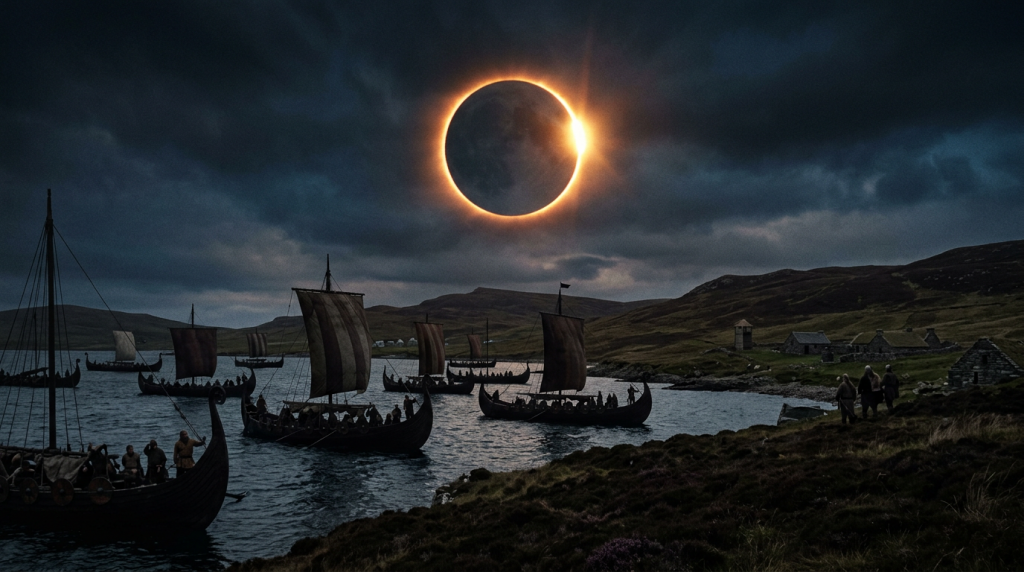
According to a popular story, its rise to national emblem began on a dark night during the 13th century, near Largs on the Ayrshire coast. A Norse force had landed under cover of darkness, hoping to surprise sleeping Scottish clansmen. To keep their approach silent, the invaders removed their shoes. However, as they crept forward, one of them planted his bare foot squarely on a thistle. His cry of pain shattered the silence, rousing the Scots and ruining the ambush. The Scots rallied, the Norse were driven back, and the humble thistle was credited with saving the day. True or not, the tale reflects how Scotland sees itself: alert, resilient and not to be trodden on.
Historically, the thistle has been tied to Scotland for centuries. It appeared on Scottish coinage as early as 1474 and later on British coins.
In 1687, James VII founded the Order of the Thistle, an order of chivalry. This is the highest honour Scotland can bestow. The thistle is its heraldic emblem, and its Latin motto, Nemo me impune lacessit (No one provokes me with impunity) fits the plant perfectly. A thistle cannot be grasped casually; it demands respect. As a national symbol, it suggests a small country that may be beautiful and delicate in flower, but is also sharp-edged and difficult to subdue.
Why is the Stone of Destiny such a Powerful Symbol of Scotland?
Among all the symbols of Scotland, the Stone of Destiny, or Stone of Scone, is one of the most powerful, because it is bound up with ideas of kingship, sovereignty and the long, often contested story of the nation itself.
For centuries, the Stone was at the heart of Scottish inaugurations and later coronations. Traditionally kept at Scone Abbey in Perthshire, it was the object on which Scottish kings were inaugurated. Its origins are wrapped in legend. Some stories claim it was the biblical Jacob’s Pillow. In other stories, it came from Ireland with the early Gaelic settlers. But what matters most is what it came to represent: the right to rule Scotland and the continuity of its kingship.
A Captured Symbol
That symbolism made the Stone a prize in times of conflict. In 1296, during the Wars of Independence, Edward I of England seized it and took it to Westminster Abbey. There it was fitted into a wooden throne. For centuries, English and later British monarchs were crowned above the captured Scottish stone. Its location was a reminder that Scotland’s royal independence had been broken and its sacred coronation stone repurposed to serve a larger, London‑centred monarchy.
Because of this, the Stone became a powerful focus for Scottish feeling, especially around questions of nationhood and autonomy. It remained a tangible link to the old kingdom of Scotland, hidden in plain sight in Westminster Abbey.
The most significant change came in 1996, when the UK Government formally returned the Stone of Destiny to Scotland. It was installed in Edinburgh Castle, alongside the Honours of Scotland. This was done with the proviso that it would travel south again when needed for a coronation. In March 2024, the Stone was moved to Perth Museum.
Today, the Stone’s importance lies less in its physical appearance and more in the stories layered onto it. It represents ancient rites at Scone, struggle with England, the survival of Scottish kingship and the modern push for self‑government.
The Honours of Scotland: Why they are such a Powerful Symbol of Scotland?
The Honours of Scotland are the Scottish Crown Jewels, and they are the oldest surviving crown jewels in Britain. Today they live in Edinburgh Castle, but they were once used in Scotland’s royal ceremonies.
Components of the Honours
- The Crown: Fashioned for James V in 1540, the crown is set with 94 pearls and 43 gemstones, including diamonds, garnets, and amethysts.
- The Sceptre: Thought to have been presented to James IV by Pope Alexander VI in 1494, the silver sceptre is topped with a crystal globe, a gold orb, and a single large pearl.
- The Sword of State: Gifted by Pope Julius II in 1507, the richly decorated sword is the oldest element of the Honours.
The Honours of Scotland and Mary Queen of Scots
The Honours first appeared together in 1543, when they were used to crown the infant Mary, Queen of Scots. However, when Oliver Cromwell came to power, the crown jewels were at risk. Cromwell had the English Crown jewels melted and turned into coins. The Scottish Privy Council were determined that Scotland’s jewels would not meet the same fate. The Honours were spirited away to Dunnottar Castle on the north-east coast. When even that stronghold became unsafe, they were smuggled out and hidden in the church at Kinneff.
The Act of Union in 1707 meant that the Honours were no longer needed for the coronation of separate Scottish monarchs. They were locked in a chest and sealed in a room in Edinburgh Castle. For more than a century they lay forgotten until Sir Walter Scott took on the challenge of retrieving them.
Since then, they have been restored to public view and to a ceremonial role. Today, visitors can see them on display at Edinburgh Castle. Also, they still appear at important occasions, such as the opening of the Scottish Parliament.
In Closing
Scotland’s symbols distil centuries of legend and history into a simple message. Scotland, although a small nation, stubbornly maintains its own identity.