Birds of prophecy have been used to predict mundane weather patterns and the serious matter of future partners for many centuries in Scotland. In Moray, where I hail from, we see a lot of wild geese that overwinter on the coastal plain. At one time, the height and direction of these arriving migrants were anxiously watched for. There was a local weather rhyme that went:
“Wild geese, wild geese, gangin t’ the sea,
Good weather it will be.
Wild geese, wild geese, gangin t’ the hill,
The weather it will spill.”
Perhaps these birds were used to predict events as far back as Pictish times.
Augury in the Time of the Picts
We now believe that the Picts were the descendants of the Caledonians and the Vacomagi. These groups were likely the descendants of the original Stone Age settlers of Scotland. In The Pictish King List, we are told that the first King was Cruithne and he had seven sons. Among the Irish Annals, however, we read that Cathluan was the first King of the Picts. This source claims the Picts came from Thrace to Ireland and then to ‘Alba’ or Scotland. Six of this company evidently stayed behind in Ireland. Consequently, the Book of Lecan notes: “And it is from them every spell and every charm and every prophetic sneeze, and augury of birds, and every charm, every omen.”
Evidence suggests that these origin theories were largely invented for political means. Nevertheless, the legends confirm that the Picts were historically associated with the practice of augury. This art of reading the bird flight patterns moved from ancient kings and druids to the common folk. As a result, the birds became the primary vessels for the Frìth—the Gaelic system of formal divination. By standing at the threshold at dawn, an observer could determine their fate based on the first wing to cross the horizon. Therefore, every species carried a specific decree, shifting the bird from a simple creature into a herald of destiny.
The Use of Birds of Prophecy and The Frìth
Birds of prophecy were central to the Frìth, yet the practice itself was far broader than bird augury alone. The Frìth was a formal system of divination traditionally attributed to the Virgin Mary. On the first Monday of each quarter, the practitioner would walk to their door at dawn with closed eyes. Upon opening them, the first sight encountered determined the fate of the household for that season.
Consequently, meaning was drawn not only from birds but from all living forms and human encounters. A man walking toward the observer was considered an excellent sign, while a man lying down suggested illness would continue. Similarly, a beast seen lying down foretold death. However, a woman standing could signal calamity, while a woman with brown hair was considered especially fortunate.
Birds still held a distinct place within this system. The approach of a bird was a sign of success, and the sight of a cock facing the observer was considered highly favourable. Conversely, the presence of a Stonechat (Clacharan) was explicitly “untoward.” A related saying reinforces this: “Chunnaic mi clacharan air clach lom, ’s dh’aithnich mi nach d’ rachadh a’ bhliadhna leam” (“I saw a stonechat on a bare rock, and I knew the year would not go well for me”).
Therefore, the Frìth should not be understood as simple bird prophecy. Instead, it functioned as a complete system for reading the world at a liminal moment, where every figure, movement, or posture became a message about what was to come.
The Cuckoo: Messenger of the Otherworld
The Cuckoo (Cuthag) was one of the major birds of prophecy. Their calls were among the most anticipated heralds of this avian oracle, though they were often greeted with caution. Hearing the bird before any food had been eaten was a certain omen of ill-luck. This was known as being “cuckooed” by the year. Consequently, people would keep a biscuit beneath their pillow in spring so they could take a bite before rising, just in case they heard the bird at dawn.
Moreover, the cuckoo was consulted as a chronological and romantic oracle. Young women would question the bird directly, asking how many years remained before marriage. The number of calls it gave in reply provided the answer. In some traditions, the direction of the call or the bird’s position could also be read as a simple yes or no, turning the cuckoo into an active participant in courtship divination.
There is an old rhyme, ‘The Seven Sleepers’ which says:
The bat, the bee, the butterfly,
The cuckoo, and the swallow,
The heather-bleet and corncraik
These creatures were thought to hibernate beneath the ground rather than migrate. Because the cuckoo was believed to spend its winters beneath the earth, it was known in Gaelic as the Eun-sìth (“fairy bird”). This belief placed it within the Otherworld, and therefore its voice was treated as knowledge carried back from beyond.
Gawk -Storm
However, the bird’s arrival marked a dangerous turning point in the year. Its call could summon the Gawk-storm, a sudden blast of unseasonable weather that demonstrated its command over seasonal change. Its behaviour also carried more immediate and personal omens. If the cuckoo called from a house-top or chimney, it was feared as a prophecy of death within that household before the year was out. Similarly, if its voice could still be heard in An t-Iuchar (July), the coming harvest would be spoiled by foul weather.
However, the cuckoo was not solely a bearer of misfortune. If it was seen singing from a craobh-sgithich (hawthorn tree), it marked a favourable day for transactions such as selling cattle or buying corn. Therefore, the cuckoo occupied a complex place in Scottish tradition. It was at once a herald of death, a keeper of time, and a messenger moving between the human world and the hidden realm beneath it.
The Stonechat and the First Sight
Stonechat prophecy depended entirely on the ground upon which the bird was first encountered during the spring. According to the Carmina Gadelica, a primary source of Hebridean lore, seeing the year’s first stonechat on soft grass was a sign of prosperity. However, seeing the bird on bare rocks or a hard road was a prophecy of a difficult, “hard” year ahead. This distinction emphasizes the “like affects like” logic of Scottish magic. Therefore, the bird acted as a reflection of the landscape’s temperament. It projected the quality of the earth onto the life of the observer. Consequently, the stonechat was a vital marker for the agricultural year.
The Magpie and the Counting of Fate
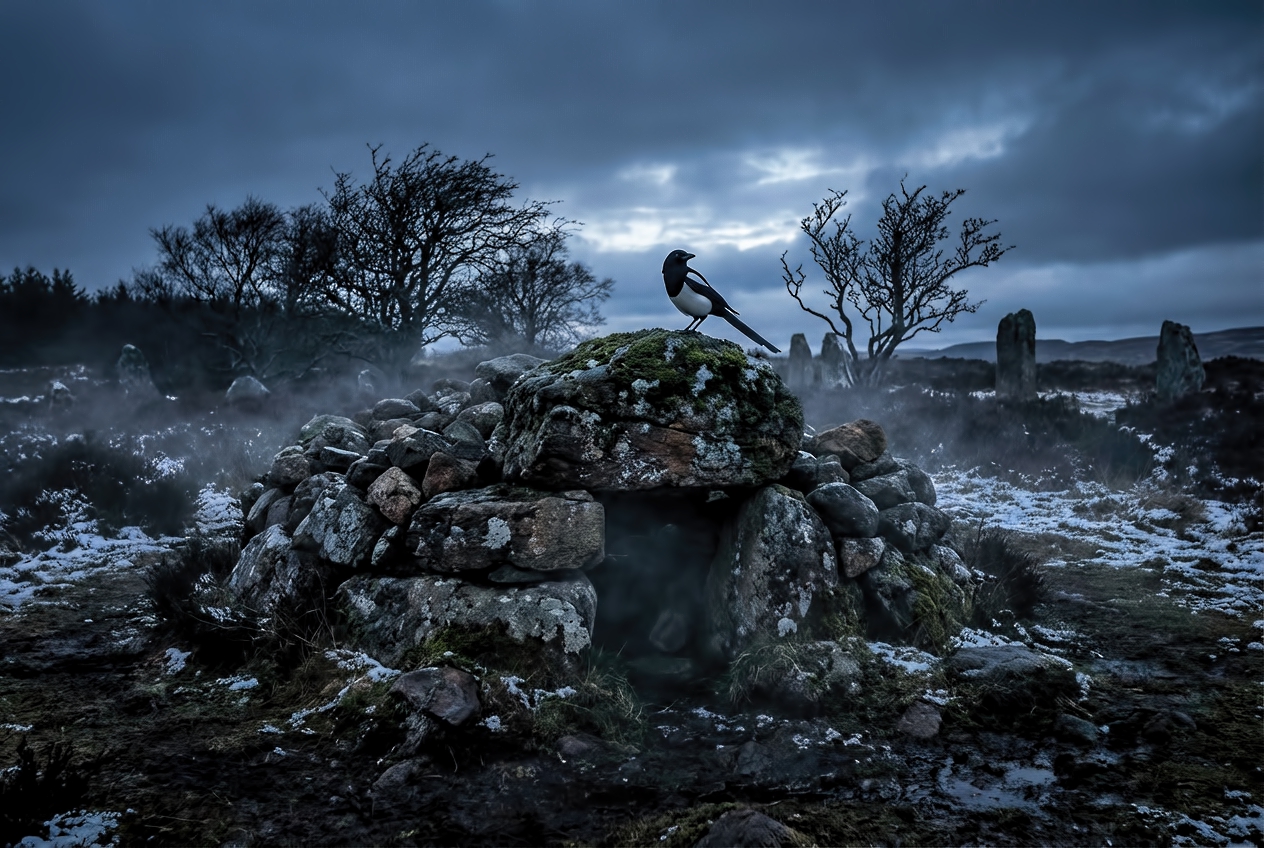
Magpie lore shifts the focus of prophecy from listening to the deliberate counting of presence. In this numerical system, the bird’s very existence acts as a barometer of future events. Most people are familiar with:
“One for sorrow, two for joy,
Three for a wedding, four for a birth…”
However, in Scotland there are some darker variations such as:
One for sorrow, two for mirth, three for a funeral four a birth,
Five for Heaven six for Hell and seven for the De’il, his nainsel
Thus, the magpie was viewed with deep suspicion. It was often said to carry a drop of the Devil’s blood beneath its tongue. This association meant that its sightings were never considered neutral. Therefore, even a single magpie necessitated a ritual greeting or a sign of the cross to ward off the malevolent prophecy it might inadvertently carry.
Despite this, the magpie was not purely negative. In some regions, one seen travelling ahead of a person predicted success. Near a home, it could signal incoming news.
Therefore, its meaning depended on context, movement, and number rather than a fixed interpretation.
The Teuchet and the Covenanter’s Betrayal
Lapwing lore represents a prophecy of exposure rather than a promise of future joy. Known in the North East as the “teuchet,” its arrival predicted the Teuchet storm.
Its historical significance, however, is rooted in the “Killing Times” of the seventeenth century. Because lapwings rise and circle with piercing cries when disturbed, they were said to betray the secret moorland gatherings of Covenanters to government dragoons. As a result, the bird’s screaming flight became a prophetic warning of impending violence. For the hiding worshipper, the sight of a rising lapwing was not a sign of spring, but a herald of death.
The Wren and the Druid’s Secret
Wren lore introduces the oldest layer of Scottish prophecy, found in its Gaelic name Dreathan-donn. This name identifies it as the “druid bird.” Its prophetic power was rooted in its secretive, subterranean habits. It was believed to hold a “wise” knowledge of the earth’s hidden movements. Because it scurried through stone walls and ancient burial cairns, the wren was seen as an inhabitant of the boundaries between worlds. Therefore, while larger birds announced fate with loud cries, the wren held the subtle secrets of the land. It did not predict the storm so much as it understood the silence that preceded it.
Later Christian tradition recast it negatively, claiming it betrayed Christ. However, older beliefs persisted. Killing a wren was thought to bring severe consequences, including harm to livestock or personal injury.
This tension shows a transition from pagan reverence to Christian suspicion, without fully erasing the earlier meaning.
The Wagtail and the Omen of Eviction
Pied Wagtail (Breac an t-sìl) foretold rain in Gairloch: “Nuair a chì thu breac an t-sìl, chì thu ’n t-uisg’” (“When you see the pied wagtail, you will see the rain”). However, the Grey Wagtail carried darker meaning. Known as Breacan Baintighearna (“the little variegated one of the Lady”), it predicted bad weather near homes.
During the Highland Clearances, its meaning shifted. If seen between a person and their house, it foretold eviction. This was called Call na Làraich (“the loss of the house site”). Therefore, a simple bird became a symbol of dispossession.
Ravens, Crows and the Lich Fowl
Raven (Fitheach) and Crow (Feannag) were among the most feared birds of prophecy. A raven on the roof signalled death: “Fitheach dubh air an taigh, fios gu nighean an dathadair” (“A black raven on the roof, notice to the dyer’s daughter”). The dyer’s daughter would prepare mourning clothes. Similarly, dreams of crows foretold grief or betrayal and hearing a raven before a journey meant failure.
One striking tradition describes a funeral contested by a crow and a dove. If the dove reached the coffin first, the soul was saved. If the crow struck first, the dead belonged to darker forces. This story reflects moral judgement expressed through bird behaviour.
Weather lore also attached to these birds. If the raven called before the crow, fair weather followed. If the crow called first, conditions worsened. Even the order of sound carried meaning.
Rooks and Environmental Signs
Rooks provided some of the most practical birds of prophecy. Their behaviour predicted weather with notable consistency. Tumbling flight, known as “cloddin,” indicated wind. Perching in rows suggested rain.
Because rooks move in groups, their agitation reflects wider atmospheric change. Consequently, they were trusted indicators.
At the same time, destroying a rookery was considered deeply unlucky. Stories claim that nothing prospered afterward. This belief likely protected colonies that were valuable for environmental observation.
The Golden Plover and the Night Warning
Golden Plover (Feadag) carried a darker association. Its night call, described as “cò-deug, cò-deug”, was believed to foretell death or evil. However, this may have been encouraged deliberately to deter intruders near illicit whisky stills.
The Snipe and Fortune
Snipe (Naosg) provided a rare positive omen. If it rose in front of cattle, it meant good fortune: “’S ann romhad a dh’èirich an naosg” (“It is in front of you that the snipe rose”). However, hearing its drumming on a Monday while hunched was unlucky.
The Robin and the Turning Weather
Robin (Brù-dearg) calls were read carefully. A subdued chirp in hedges foretold poor weather. However, cheerful evening song promised improvement. Therefore, tone mattered as much as presence.
The Dove, Harrier and Thrush
Seeing a Dove (Calman) first thing in the morning was a good omen. Similarly, the Hen Harrier (Clamhan nan cearc) was considered fortunate. The Song Thrush (Smeòrach) brought luck if it entered a home voluntarily. Consequently, some birds carried blessings rather than warnings.
Weather Birds and Everyday Omens
Many birds of prophecy functioned as practical weather signs. Swallows flying low indicated rain, while high flight suggested fair conditions. Gulls moving inland signalled storms.
Other birds combined weather with fate. The owl’s cry foretold flooding. The blackbird’s strong song predicted rain. In contrast, the skylark singing in poor weather promised improvement.
These signs show how observation and belief merged. The same behaviour could be read both scientifically and symbolically.
Birds at the Threshold of Fate
Birds of prophecy in Scotland reveal a consistent pattern. They operate at boundaries. Dawn, seasonal change, life and death, and land and sky all serve as contexts for interpretation.
This explains why birds held such importance. They move between worlds in a literal sense. Consequently, they became ideal carriers of meaning.
Rather than random superstition, Scottish bird augury reflects a structured way of understanding uncertainty. It combines environmental knowledge, symbolic logic, and cultural tradition into a single system.
Sources:
- Malcolm Archibald: Scottish Animal and Bird Folklore (1996)
- Walter Gregor: Notes on the Folk-Lore of the North-East of Scotland (1881 Republished 2007)
- Robin Hull: Scottish Birds: Culture and Tradition (2001)
- David R. Kelday: Scotland’s Birds and Folklore (2018)